
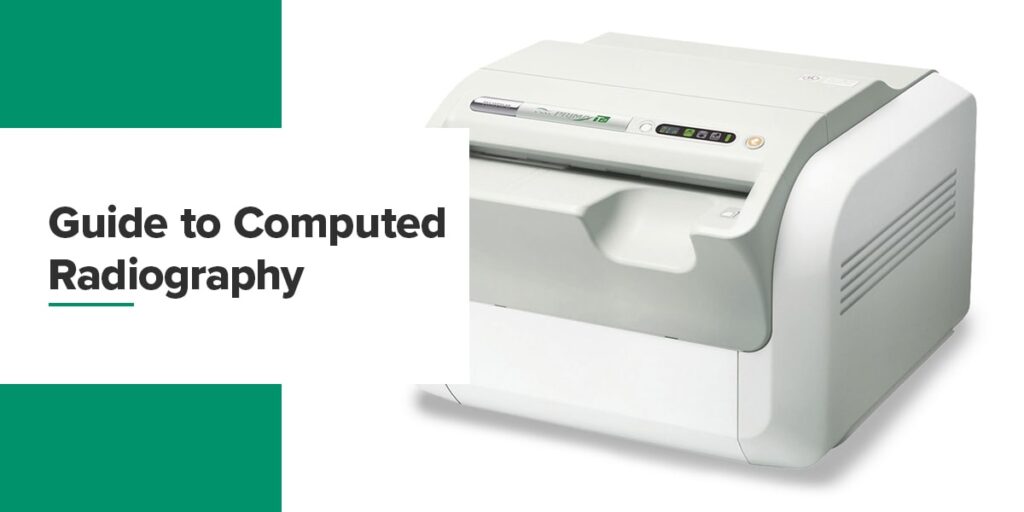
What is Computed Radiography?
Computed Radiography (CR) is a type of Digital Radiography (DR) that replaces traditional X- ray imaging. Unlike traditional X-ray systems, CR systems use photostimulable phosphor imaging plates to capture images instead of the conventional film screen.
Upon radiation exposure, the plate captures an image of the test object. This is one of the main similarities to X-ray film testing. The CR system uploads the image to a computer program for analysis, instead of going through dark room processing. With this software you can adjust and apply digital enhancements as needed to make informed and easier analysis.

Benefits of Computed Radiography
Computer Radiography brings many benefits that are crucial for improving safety and operation standards. This easy-to-use technology increases the accuracy of inspections and helps detect issues early. Below are some of the advantages and benefits it offers:
- Time savings: With CR technology, you’ll process images within a few minutes. This rapid turnaround time can help you improve testing efficiency and throughput.
- Cost-effectiveness: You can save money on materials as CR imaging plates are reusable almost immediately after erasure.
- Chemical- free: You don’t need to use developer solution to produce an image for analysis, like in X-ray radiography. Plus, you won’t need to store processing chemicals – freeing up space and reducing overhead costs.
- No darkroom: Unlike X-ray radiography, CR systems don’t need a dark room to expose images which reduces time in processes and money invested.
- User-friendly: You will work more efficiently with this robust digital imaging software than traditional film as it’s easier to use.
- Image quality: Unlike with X-ray film, you can adjust CR images to remove background noise and improve image clarity.
- Data storage: You have better accessibility , data security, team collaborationby having all you information saved in one cloud system.
- Sustainability: You can reduce consumable usage and become more environmental and financially friendly by using these reusable plates.
Computed radiography does have some disadvantages. The risk of damaged equipment is one of the main drawbacks, as CR cassettes are susceptible to damage from mishandling or abuse.
It is also true that CR imaging is more cost-effective than other digital systems, especially for businesses entering the digital NDT space for the first time. Carefully consider your organisation’s needs before choosing an NDT system.
What Are Components of Computed Radiography?
Computed radiography systems comprise several hardware and software components that perform each part of the imaging process.
These are the 5 main parts of a CR system:
- Radiographic generator: This device emits the necessary radiation to create an image on the plate. If the CR system is compatible with your existing equipment, you may be able to continue using your generator.
- Imaging plates: CR systems use cassettes containing reusable phosphor plates rather than film. You can erase and reuse these plates thousands of times, significantly reducing the need for consumables.
- Image reader: The reader replaces the darkroom of conventional X-ray testing. Rather than applying chemical solutions to an exposure to reveal the image, CR readers scan the phosphor plate and digitise the image. They then transfer the image to the workstation.
- Workstation: Most CR radiography systems use a standard PC to view, evaluate and send digitised images.
- Software: Diagnostic imaging software provides a consolidated platform for storing, analysing, and managing test images. This software streamlines file management and optimises analysis processes.
Proper system maintenance is critical for ensuring high-quality test images. For example, you must erase imaging plates after each use because residual energy can create ghost images in later exposures. It’s also important to regularly erase unused plates, which can capture faint images even while not in use.

How Does Computed Radiography Work?
Here’s a brief step-by-step explanation of how the process works.
- Exposure: First, you expose the imaging plate and test object to radiation to capture a latent image. This radiation may be X-rays or gamma rays, depending on your application. The energy from the radiation remains trapped in the plate’s phosphor layer.
Exposure time and image quality can vary depending on the type of plate you use. Other system components, like your scanner or display monitor, can also influence image quality. - Digitisation: You then insert the cassette into the CR reader, which scans the plate by applying a focused laser beam to it. The plate emits a bright blue light in response, allowing the reader to pick up the image on the plate.
Using an analogue-to-digital converter (ADC), the scanner turns the light into a digital signal, which it transfers to the computer. Then, it wipes the image from the plate using a high-intensity light source. - Analysis: Once the converter has transferred the image to your workstation, you can begin analysis. Your diagnostic software allows you to manipulate the image for more in-depth analysis. You can also reuse the plate immediately after erasure as needed. Depending on the brand of plates you use and your specific application, you may be able to reuse one plate more than a thousand times.
Your analysis software allows you to alter the image and view it from different angles to get a clear, comprehensive view of the test object. Each software program has different features and capabilities, so it’s important to choose the right one for your business.
Your analysis software allows you to alter the image and view it from different angles to get a clear, comprehensive view of the test object.
Some helpful features to look for include the following:
- Automatic measurement tools
- Digital contrast normalisation
- Smooth transitions between screens
- Traceability and reliable image quality assessment
- Flexible network configuration
Ideally, your analysis software will fit seamlessly into your CR system. Choosing one manufacturer and developer for all your system components is ideal for ensuring smooth integration.
How is Computed Radiography Different From Traditional X-Ray Testing?
CR radiography effectively replaces X-ray testing by digitising the darkroom process. Like X-ray testing, CR imaging uses cassette-based media and radiation to capture images.
Some other key differences between the two include:
- Consumables: Processing images using film requires darkroom chemicals, single-use film and other consumable materials. You can produce thousands of images through CR radiography with a computer and a CR reader.
- Environment: You need to keep X-ray images in a temperature- and humidity-controlled environment to prevent the film from warping or distortion. However, with CR imaging, you can store images on your workstation, eliminating the risk of image degradation resulting from environmental factors.
- Location: Film development must take place in a darkroom, which poses a challenge for many industrial facilities. As a result, many businesses using X-ray testing must process their images off-site, which adds to the processing time. Fujifilm’s computed radiography systems can easily fit into narrow spaces, saving you valuable floor space and time.
While X-ray testing has been the standard in image-based NDT for decades, transitioning to a CR system can help bring businesses into the modern era. Faster processing times, and easier informed analysis enable companies to increase testing throughput and meet deadlines quicker. This is essential for staying competitive in today’s fast-paced world.
How Is Computed Radiography Different From Direct Digital Radiography?
While CR and direct Digital Radiography (DR) are both digital forms of NDT, they are different techniques.
The main difference between the two is in the equipment each system uses. Where a CR system uses flexible cassettes containing imaging plates, DR systems use flat-panel detectors, or digital detector arrays (DDAs) to capture images.
DDAs convert applied X-rays into electrical charges, which enter the transistors and produce a digital image in real time. As a result, DR is often much faster than CR testing.
Many businesses use CR as an intermediate step to totally digital systems like DR. CR is usually compatible with their existing X-ray equipment, so they can implement it without investing in an entirely new system. All they need to get rid of is their darkroom and film processing equipment – this is even more cost effective.

Industrial Applications of Computed Radiography
Computed radiography applications include almost any NDT process involving X-ray radiography. It can be useful for businesses in most industries, including the following.
Aerospace
The aerospace industry must adhere to stringent safety and quality regulations to protect passengers and cargo. Aircraft frequently travel through demanding environments that can accelerate wear and tear on sensitive internal components. Radiography testing is essential for catching defects early before they can lead to catastrophic failure.
CR can help manufacturers verify their airplanes’ safety by testing for subsurface defects. It’s also useful for identifying and monitoring signs of aircraft fatigue without causing additional damage to the plane’s delicate internal structures.
Automotive
Digital radiography techniques like CR and DR provide rapid results, which means they’re suitable for use in automotive manufacturing facilities. Implementing CR testing in-line speeds manufacturing by eliminating the delays common to destructive testing methods.
Because CR virtually eliminates consumable usage, it may also reduce supply chain issues that can interfere with timely vehicle production.
The speed of computed radiography can also help technicians improve repair and maintenance efficiency. Technicians can test the affected vehicle or component, then quickly pinpoint the source of the problem using advanced analysis software. Faster repairs can significantly improve customer satisfaction and increase profits.
Construction
Computed radiography can help construction companies modernise their operations by digitising inspections and image management.
Like conventional X-ray equipment, CR systems help construction professionals detect and identify internal structure characteristics such as voids, wire mesh and cooling lines.
Plus, because CR takes less time to process images, it streamlines inspections. Site managers can keep projects moving along much quicker, allowing for faster project completion.
Gas and Oil
CR digitises the imaging process, which can help gas and oil companies modernise and streamline testing procedures. They can also cut operational costs by eliminating the need for single-use consumables.
This digital radiography technology offers testing technicians a clear view into the health of their welds, piping and valves, enabling them to identify issues like:
- Internal corrosion
- Corrosion under insulation (CUI)
- Poor quality welding
- Pipeline blockages
- Cracks and breakage
Technicians can share, email and digitally store the images in minutes rather than over several hours.
CR is especially powerful for this industry when combined with other advanced processing techniques like geometric magnification.
Defence
Computed radiology, a key player in Non-Destructive Testing (NDT), is also pivotal for the UK’s defence sector. This technology enables thorough analysis of military assets without dismantling, preserving their integrity and saving time.
Given the high-stress conditions defence materials are subjected to, CR excels in detecting subsurface defects and measuring lamination thickness, crucial for maritime, aerospace, and ground-based military assets.
The high-resolution imagery it provides uncovers flaws like cracks or laminations, facilitating timely corrective actions. Coupled with other NDT techniques, CR significantly enhances asset integrity management, optimising operational readiness and financial efficiency of operations, while prioritising safety and prolonging equipment lifespan.
Nuclear
Computed radiology within Non-Destructive Testing (NDT) is an asset to the nuclear sector, enabling detailed analysis of materials and structures without compromising their integrity. Here are 3 key points on how NDT can be used within this application:
- Fault detection: Through high-resolution imaging, CR identifies subsurface defects like cracks or corrosion, critical in maintaining the structural integrity of nuclear facilities and ensuring safety.
- Material thickness measurement: This technology accurately measures material thickness and detects any diminution due to wear or corrosion, vital for adhering to the rigid safety standards of the nuclear industry.
- Timely maintenance: Providing a clear insight into the internal conditions of components, computed radiology facilitates timely maintenance decisions, helping prevent potential catastrophic failures and ensuring continuous operation of nuclear facilities.
How We Can Help
If you need advanced imaging solutions for your NDT application we can help you find the right system to meet your needs.
Streamline critical NDT applications such as parts inspection with the Fujifilm DynamIx HR2 CR system and DynamIx VU NDT imaging software.
DynamIx HR2
The DynamIx HR2 is a compact, user-friendly CR system suitable for use in any industry. Simply insert the image plate into the reader and process your images — the HR2 will eject the plate once the process is complete. Once your image is processed, you can perform multiple analysis operations quickly and easily, allowing you to obtain a comprehensive look into your test object.

The DynamIx HR2 reads imaging plates of various different sizes, including up to 152 centimetres long. Additionally, the device’s reading density spans from 25 to 200 μm. Custom options are also available for organisations with more specialised needs.
DynamIx VU
Our industry-leading NDT imaging software provides superior CR image quality and a wide dynamic range, allowing you to analyse test images with confidence in your results. This user-friendly software suite simplifies workflow and data management, streamlining inspections and enabling you to maximise return on investment (ROI). It’s also adjustable and adaptable to all types of testing.

DynamIx VU is suitable for inspecting many different types of components including:
- Electronics: The software is suitable for use with sensitive electronic components like printed circuit boards (PCBs).
- Automotive: DynamIx VU can help you inspect mechanical parts like rotors, crankshafts and gearboxes.
- Aerospace: Inspect welds, investment casting and other mechanical components to ensure compliance with regulatory standards.
- Defence: Measures lamination and uncovers cracks for maritime, aerospace and ground-based military assets.
- Nuclear: It can identify defects like cracks or corrosion, and measure material thickness and reduction due to wear or deterioration.
New, advanced features can help ensure more efficient inspection. DynamIx VU Thickness, our automatic measurement tool, allows oil and gas professionals to precisely determine pipe thickness by detecting both edges of the pipe wall and taking a focused measurement.
Additionally, DynamIx VU supports a wide variety of general and industry-specific standards for automated quality assessments. You can choose which parameters to test, and the software will do the rest.

Choose Fujifilm for Computed Radiography Solutions
At Fujifilm, we provide cutting-edge NDT solutions for multiple industries and applications. Whether you need a digital radiography solution for oil and gas pipeline testing, nuclear power facilities, defence, or any number of other industries – we can help.
Contact us today for more information about how our computed radiography systems can improve your operations, or browse all our NDT products to learn more about our offerings.